



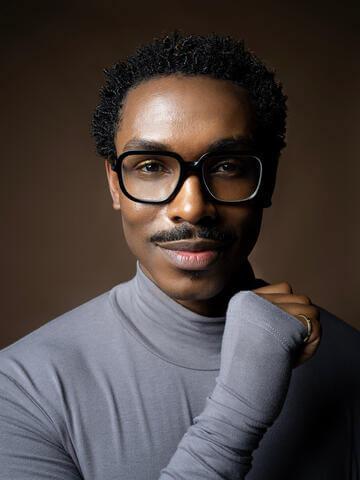
I often trace the beginning of my story back to something my father, a U.S. Air Force veteran, taught me early on. He gave me a mantra he insisted I memorize and recite: “I am valuable because God made me.”
I didn’t understand then how deeply those words would anchor me, but they became a through line — something I carried into every space, every challenge, and every version of myself I grew into. As I got older, that mantra evolved into my own personal declaration: “I am endowed by the Universe to be who I am.” Together, those two truths, my father’s and mine, formed the foundation that held me through moments of fear, joy, uncertainty, and possibility. Atlanta, Georgia, is where that foundation came alive.
In adolescence, I became part of a small but magnetic circle of Black men and women navigating our queerness quietly, carefully, and courageously. We weren’t a broad underground community — just a handful of us connected through the National Society of Black Engineers, Southern Polytechnic State University, Georgia Tech, and the SpelHouse communities, each of us drawn to one another in a world that wasn’t always safe for us. Yet in that closeness — on dance floors, during late-night conversations, and in the laughter we shared — I experienced something profound: the joy and safety of being loved in full.
Those moments were like pocket dimensions of safety carved out of a world that wasn’t always safe. They were tender, electric, and affirming. Dating, dancing, being seen — those experiences gave me context for my identity that no textbook ever could. They challenged me, refined me, and ultimately deepened the pride I carried as a Black gay man. By the time I arrived at Howard University in 2012, I wasn’t searching for who I was. I was informing who I was with new layers of purpose. That purpose crystallized further on Capitol Hill, where I served as a congressional science fellow during the 113th Congress (2014-2015) in the office of Rep. Frederica Wilson.
Establishing Howard’s Lavender Fund When wrapping up my time on the Hill, I carried all of that grounding and self-knowledge with me into my decision to run for Howard’s student government in spring 2015. I ran because I knew I had the skills, policy experience, and conviction to advocate for graduate and professional students whose needs were too often overlooked. Although I was confident in my purpose, I was still a scientist stepping into a political role — nervous about public speaking and learning to find my voice in real time. But conviction steadied me, and authenticity made me brave.
Historically, students from the School of Law dominated the Graduate Trustee seat, yet I became the first person elected from the university’s Department of Anatomy, founded in 1868 and one of the smallest departments on campus. That victory wasn’t just symbolic — it was a reminder that influence and impact aren’t determined by size or visibility. Even those of us who come from small corners of institutions can rise, lead, and be trusted to represent the whole.
KNOWLEDGE BECAME MY FUEL. EMPOWERMENT BECAME MY COMPASS. COMMUNITY BECAME MY PROTECTION.
When I won the Graduate Trustee position, I became the first openly gay man in Howard’s 150-year history to hold that role. The victory wasn’t mine alone — it was buoyed by the Black gay and queer men who believed in me, the Black women who lifted me up, and non-Black allies in D.C. whose solidarity was genuine, consistent, and unwavering. I wasn’t perfect, and I wasn’t fearless. I simply had people who refused to let me shrink.
All those moments of safety, affirmation, and chosen family stayed with me — the pockets of protection that held my identity long before institutions ever could. As I stepped into the leadership role at Howard, I realized that those pockets weren’t accidents. They were lifelines. They were architecture. If they could exist for me in dance studios, dorm rooms, policy offices, and late-night phone calls, then they could exist on campus in a structured, intentional way.
I didn’t recognize it that way at the time, but looking back, the Lavender Fund was born from that same instinct: to create within the university the kind of connected, affirming micro-communities that once held me steady, not just through financial support but through visibility, belonging, and a quiet assurance that you are not alone.
The Lavender Fund, which I established in 2015, began as a simple but urgent idea. Underneath that simplicity was the deeper hope that we could seed these same pockets of safety within Howard’s fabric. It wasn’t just about providing emergency support. It was about creating visibility, affirmation, and connection. It was about ensuring that LGBTQ+ students could be fully themselves and fully supported, the way I had been supported by communities who saw me before I fully saw myself. What has happened in the decade since the fund was created has more than confirmed that instinct.
Today, as the Lavender Fund reaches its 10th anniversary, it stands as a transformative force — a testament to what love, strategy, and community can build together. Since its founding, the fund has supported more than 50 LGBTQ+ students across undergraduate, graduate, and professional programs. Their stories are diverse, courageous, and often quietly heroic.
As I reflect on these past 10 years, I return to the mantras that shaped me: “I am valuable because God made me,” and “I am endowed by the Universe to be who I am.” The Lavender Fund echoes those truths back to every student it touches. Even in times of despair, faith in yourself will rescue you. The next decade will come with challenges that strengthen that echo — louder, broader, and powerful enough for every LGBTQ+ Bison to know deeply and irrevocably: You belong here. And your future matters.
Howard’s Interim President Wayne A. I. Frederick, M.D., MBA, and Mrs. Simone Frederick have been the fund’s most steadfast champions. In a recent video message shared at the 10th annual Lavender Reception during Howard’s 2025 Homecoming celebration, President Frederick said, “The Lavender Fund has changed Howard’s culture and gave visibility to students who often felt unseen a permanent place in our community. Today, Howard cannot be imagined without it.”
His support has been transformative. Since the fund’s inception, President Frederick and his wife have matched the donations raised for the fund each year, helping it grow from idea to institution. When we launched a campaign to establish a $100,000 permanent Lavender Fund endowment earlier this year, President Frederick announced, “My wife and I will continue to match all the funds that are raised by the Lavender Fund. If the fund reaches its goal of $100,000, we will match with a gift of $150,000.”
President Frederick captured the heart of its impact when he said, “The most powerful moments have been hearing directly from students how this fund gave them the courage to pursue their dreams, to be their authentic selves, and to know they belong here.”
That is what I am most proud of — these pockets of belonging, once rare and fragile, now reverberate across Howard’s campus. As we look ahead, the next decade calls us higher. By 2030, I hope to see a Lavender Fund research grant supporting innovative LGBTQ+ wellness scholarship. By 2035, I envision an endowed professorship dedicated to LGBTQ+ research and leadership embedded into Howard’s academic core. Achieving this vision requires a community of givers — financial, relational, and visionary.
Ways to support the next decade of the Lavender Fund:
• Financial contributions: Expand emergency aid and help build a permanent endowment.
• Mentorship and career support: Connect students to networks where representation still lags.
• Visibility and advocacy: Champion the fund’s mission and uplift LGBTQ+ students.
• Community presence: Show up. Celebrate them. Hold space.
To donate to the Lavender Fund’s current fundraising campaign to establish a permanent endowment fund, visit givecampus.com.
Christopher N. Cross (M.S. ’14, Ph.D. ’19) is the founder and principal strategist of The Strategy Lab, a former member of Howard’s Board of Trustees and the College of Pharmacy Board of Visitors, and founder of the Lavender Fund.
Article ID: 2526