




AUGUST WILSON IN CONTEXT
ESSAY BY KHALID Y. LONG, PH.D., CO-EDITOR
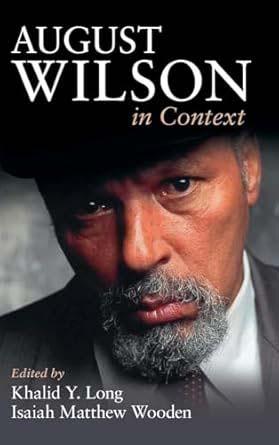
When the opportunity to edit a new collection of critical essays on one of the world’s most influential literary figures, August Wilson, arose, I jumped at it immediately. It was the kind of invitation many scholars spend their careers hoping to get. I asked Dr. Isaiah M. Wooden, a theatre and performance scholar and currently the chair of the department of theatre at Swarthmore College, to work with me as co-editor. (He is a talented editor, and partnering with him was truly a gift.) As we discussed the scope of the project, we agreed that the main focus was a new body of scholarship that not only highlighted Wilson’s role as a major force in arts and culture but also advanced Wilson studies into new areas.
Guided by this vision, we invited scholars and critics to craft chapters that examine Wilson’s reputation in contemporary theatre and drama, offering distinct critical and contextual analyses of August Wilson and his American Century Cycle. It brings together a notable group of scholars and artists to deliver fresh and compelling insights into Wilson’s life, practices, and contributions as a playwright and public intellectual. In assembling the chapters, our goal was partly to help readers gain a deeper understanding of the conditions and circumstances that shaped and influenced Wilson’s artistic work. We also aimed to place Wilson’s oeuvre within broader social, cultural, political, and aesthetic contexts.
The collection’s chapters, written by a diverse group of scholars and critics, are organized into four themed sections. Contributors include Sandra G. Shannon, Professor Emerita at Howard University; Laurence Glasco, who explores Wilson’s connection to Pittsburgh, the setting for all but one of his plays; and Sandra L. Richards, who examines his relationship with the African diaspora. Aviva Neff’s chapter, “After the Reckoning: Revisiting ‘The Ground on Which I Stand’ in the Wake of Black Lives Matter,” considers Wilson’s early leadership in promoting equity and inclusion in commercial theatre, preceding the Black Lives Matter and We See You White American Theatre movements.
Divided into four thematic sections, Part 1, “Influences and Inspirations,” explores the social, cultural, and aesthetic forces that shaped Wilson’s creative work. Part 2, “Politics and Debates,” analyzes the major arguments and critical exchanges central to Wilson studies. Part 3, “Productions and Collaborations,” examines the production contexts of his plays and reflects on Wilson as a collaborator, including roundtables with his artistic partners and with directors and designers who have continued staging his work. Part 4, “Critical and Comparative Contexts,” offers new analyses of Wilson’s dramaturgical strategies. In addition to co-writing the introduction, my chapters include “Cultural Magpies: A Conversation with Jack Magaw and Christina García” and “Redefining American Theatre: August Wilson and David Henry Hwang,” where I consider how both playwrights reshaped American theatre through their work and advocacy, further suggesting that their pioneering efforts make them imaginative interlocutors.
The study of August Wilson shows how powerfully his plays preserve the African American voice across the 20th century. His work not only documents history but also transforms it, using the stage to confront issues of identity, legacy, and social justice. This project was a labor of love, and I hope it proves to be valuable.
KHALID Y. LONG, PH.D., co-editor of “August Wilson in Context,” is associate dean of research and creative endeavors and interim chair and associate professor of theatre arts in the Chadwick A. Boseman College of Fine Arts at Howard University.
NEW YORK TIMES BESTSELLING AUTHOR TIFFANY D. JACKSON TALKS NEW BOOK, ‘THE SCAMMER,’ AND HOW HOWARD CONTINUES TO INSPIRE HER
By Tiffani R. Alexander
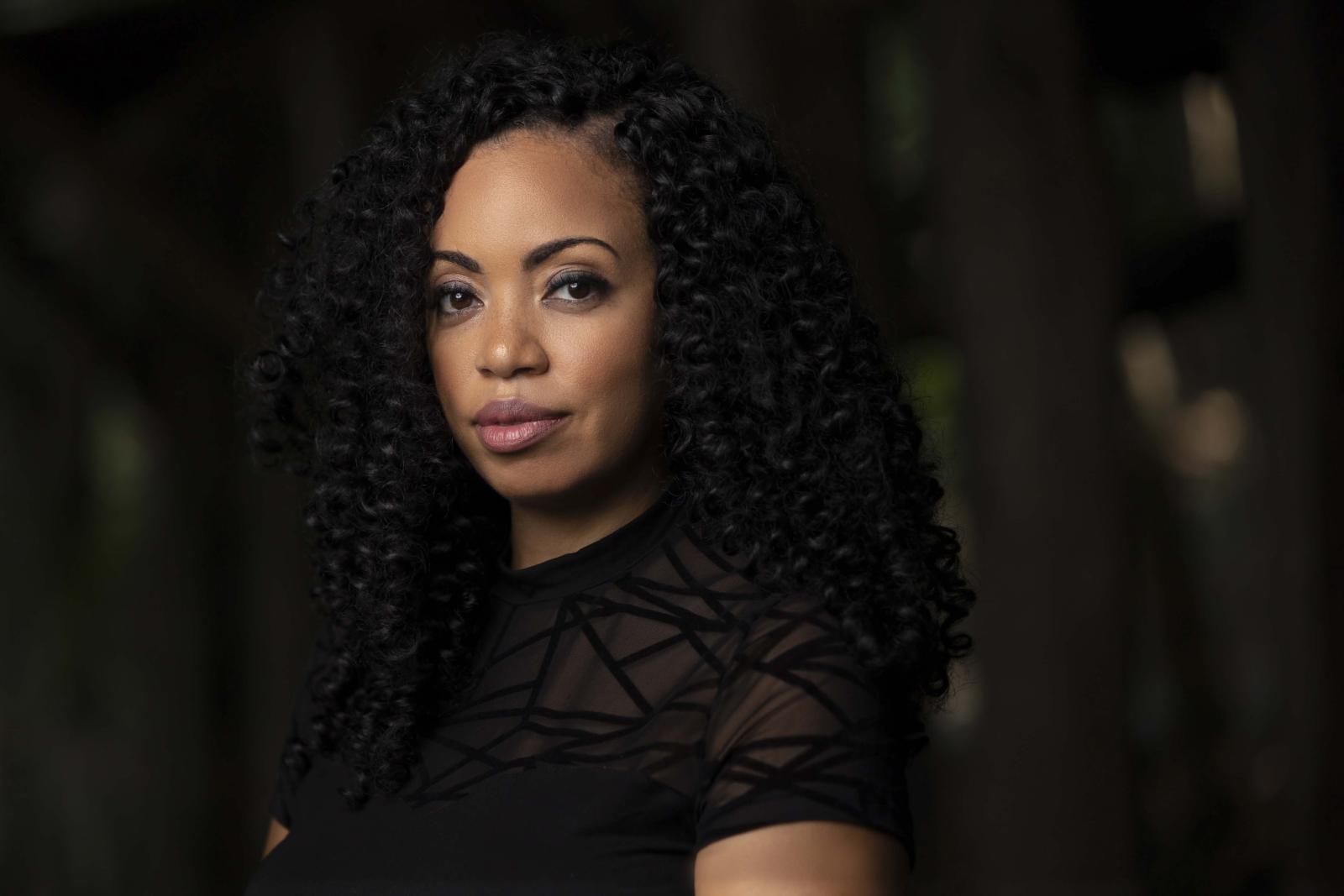
Award-winning young adult author and horror filmmaker Tiffany D. Jackson (B.A. ’04) is often inspired by the world around her, creating art that is reflective of life. This was the case with her latest novel, “The Scammer.”
“Most of my books are loosely inspired by real cases or real events,” said Jackson, before clarifying that’s not the case for her middle grade books. (“Little kids will definitely look up things; I don’t want to give them nightmares!”)
“The Scammer is no different,” she said. “It was loosely inspired by a case that happened at Sarah Lawrence College.”
In 2010, an ex-convict moved into his daughter’s dorm room and established what was referred to as a sex cult among her friend group and dormmates. He established himself as a father-like figure, earned their trust, and went on to exploit, abuse, and terrorize them for years. The story received national attention and ended up on the pages of the likes of Vanity Fair and The Cut.
“I remember reading a very detailed article in the Cut, and saying to myself ‘this would never happen with Black kids.’ And then I started to think about it and processing my own freshman year at Howard,” said Jackson, noting that while nothing close to this case actually happened at the university, there are “sharks in the water” everywhere, and cults are not unheard of. “We don’t talk about how cults are very active in the Black community because cults oftentimes in the Black community go by a different name.”
The fact remains that young adults on college campuses are often susceptible to bad actors within their proximity who prey on their naivety. Calling it their most “vulnerable time,” Jackson explained that “your freshman year is most likely your first time away from your family; outside of your bubble — you are being exposed to so much and you’re questioning things.”
WE DON’T TALK ABOUT HOW CULTS ARE VERY ACTIVE IN THE BLACK COMMUNITY BECAUSE CULTS OFTENTIMES IN THE BLACK COMMUNITY GO BY A DIFFERENT NAME.
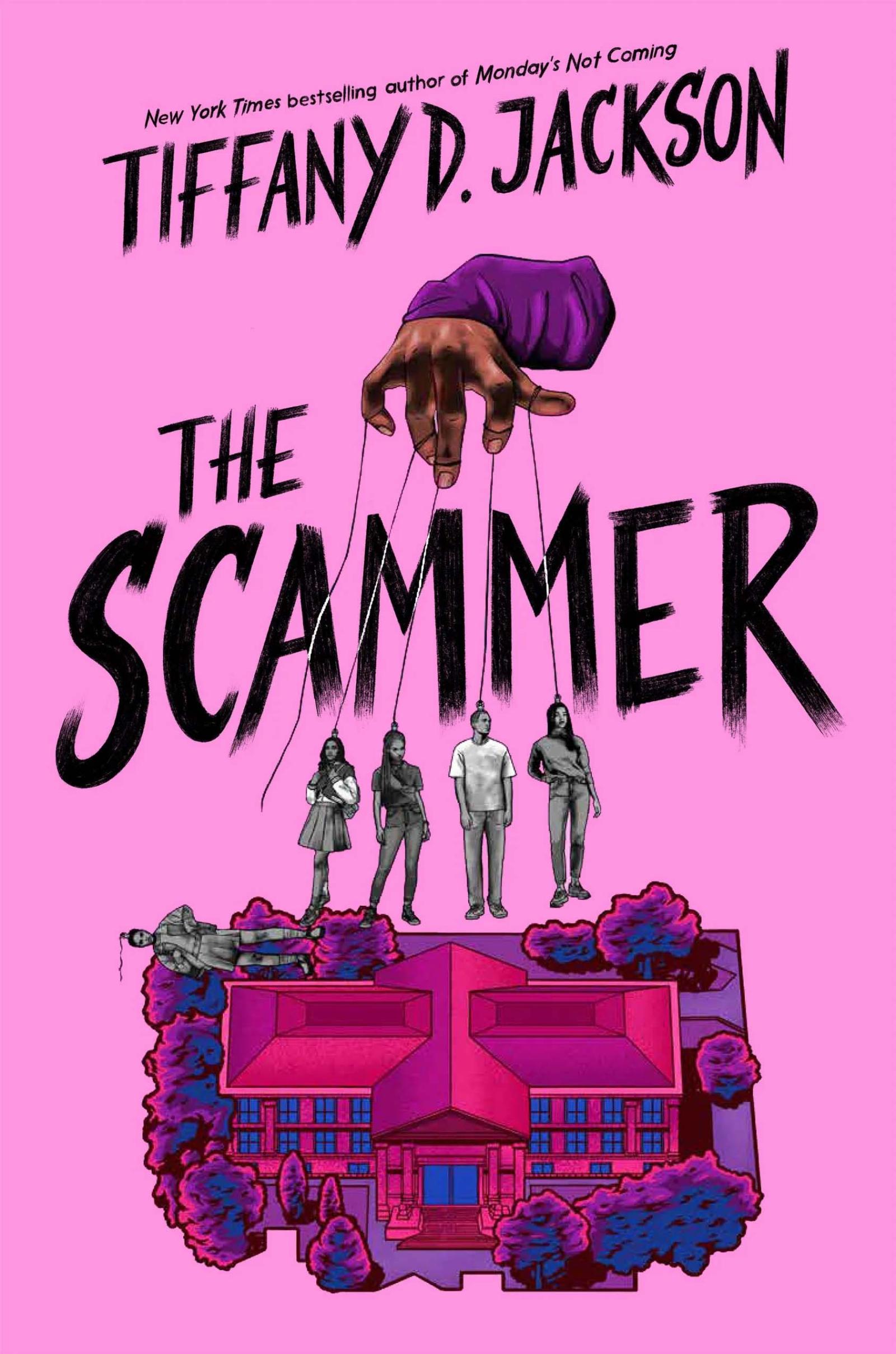
“That’s what really inspired this [novel],” she continued. “The idea of something like this, if some type of cult were to happen on a college campus, what would that look like and how would our community respond to it? This is obviously not fashioned after Howard per se, but it was fashioned after the love of HBCUs, period.”
The events in “The Scammer” take place at a historically Black college in Washington, D.C., and the Bison took a little inspiration from her alma mater when it came to a professor in the book, the naming of a student group on campus, and more.
“The student union is called FUSA and not HUSA, and there’s an African studies teacher that reminded me of Dr. Carter,” said Jackson.
However, even if she fashioned the school after Howard, the author points out that many schools have a student union or dorm rooms with etiquette that must be followed, for example.
“It’s all very similar,” she said. “It’s like a bit of an echo, I suppose.”
Those echoes include a dorm at the bottom of a hill where the book’s main character gets her first glimpse of life on campus. In the fictionalized, prestigious HBCU — Frazier University — Jordyn Monroe is a prelaw student determined to leave a painful past behind her as she begins her college journey in Washington, D.C. She moves into a quad on the sixth floor of Rockland Hall (“The Rock”) and meets her four roommates. Just as she begins to grow her friendships and get her footing at the school, things get weird. One day, she returns to her dorm room, only to realize that her roommate Vanessa’s ex-convict older brother, Devonte, is now sleeping on their sofa.
In need of a place to crash as he gets back on his feet, Devonte soon charms many of the dorm’s young residents. They find him smart, attractive, and funny; some even look to him for advice on navigating life. Jordyn, however, senses something sinister under the surface. As his followers grow, so do her suspicions, and when one of her roommates actually goes missing, she takes it upon herself (enlisting the help of “White boy Nick,” the only white student at Frazier University) to get to bottom of things.
Howard Made
Jackson’s time at The Mecca did much more than inspire characters, names, and places in her work.
“It definitely changed my life,” she began, noting that Howard wasn’t the film major’s initial school choice and that she intended to transfer. “I got there and within two weeks I was like, oh, I’m here for life! It’s single-handedly the best decision I ever made.”
ONE OF THE BIGGEST THINGS I LEARNED IS HOW TO HUSTLE. WHETHER IT’S THE CONVERSATIONS THAT YOU’RE HAVING WITH TEACHERS OR AT THE ADMINISTRATION BUILDING, YOU REALLY LEARNED HOW TO ADVOCATE AND HUSTLE AND MAKE THINGS HAPPEN.
She went on to note the network she built at Howard, but most importantly the friendships and “family” she fostered on The Yard and beyond — a fact evident in the dedication to her “Bison Babes” that graces the front pages of “The Scammer.”
“I feel so loved and supported by my community; everywhere I go I bump into Howard Bison,” Jackson said. “Even before when I used to work in television for like 15 years, I would run into Bison everywhere I went, overseas, everywhere. It’s just always like having one big family that really supports you; it is the best feeling you can ever get.”
The author credits the university with her ability to make things happen, no matter the industry.
“I was a film major at Howard; I actually didn’t study writing. But one of the biggest things I learned is how to hustle,” she said. “Whether it’s the conversations that you’re having with teachers or at the administration building, you really learned how to advocate and hustle and make things happen. And that is something I took with me to the television world, and I continue to take with me even in my publishing world, that you can’t just sit by and be reactive. That was a big part of my experience that shaped me overall.”
While Jackson studied film at Howard, she knew she wanted to write professionally someday.
“I always wanted to be a writer,” she said. “I always wanted to be an author. I just always loved writing and reading. And honestly, I was scared to try to be an author.”
That all changed due to an encounter at The Mecca.
“Howard was the first place I met my first-ever author who actually inspired me to tell the type of stories I write today, and that was actually Sister Souljah,” explained Jackson, who at the time had to be convinced by friends to attend the event, a part of the Sister2Sister tour. “I remember going up to her afterwards — I bought a book with my little bit of coins I had left; I got her to sign a book. So, it was my first author signing, and I suddenly just blurted ‘I want to be an author.’ And she was so encouraging.”
The budding author was inspired to read more works by women with “very powerful messages” following her introduction to Souljah’s “The Coldest Winter Ever,” rereading the likes of fellow Bison Zora Neale Hurston (A.A. 1924) and Toni Morrison (B.A.’53, H ’95) through a “different lens.” She says this time in her life greatly impacted her and reignited a belief in a dream she’d had since childhood to be an author and create.
“I love film and television; it’s very much, you know, a first cousin to books,” she said. “I always knew I just wanted to be a creative storyteller.” When asked what advice she has for aspiring writers, Jackson referred to her own unique path to becoming a bestselling, award-winning author. “I wouldn’t change a thing about my journey,” she said. “It took me a while to get to this place to be an author, but I gained so much experience — I had so much life experience and that’s what makes you the best type of author — growing through life.”
She believes a good writer must also be a good reader.
“My biggest piece of advice is to read,” Jackson said. “Read widely and read actively, that is the way you learn how to become a better author.”
The author of “Allegedly,” “Monday’s Not Coming,” “Blood in the Water,” “White Smoke,” and more gave an additional piece of advice shared during her junior year by a former HU professor that many of us have likely heard a time or two.
“One of my film professors said famously, ‘fake it until you make it,’ and you know honestly, that has been lifechanging advice. You may not know what you’re doing, but you will figure it out. I think that’s the best solution I ever had in my film career and in my writing career, to just fake it till you make it. And I feel like I really made it.”
What’s Next?
A new middle grade novel is due to arrive in 2026 titled “Ghost in the Night,” and a book she co-authored with writers Dhonielle Clayton, Nic Stone, Angie Thomas, Ashley Woodfolk, and Nicola Yoon, “Blackout,” is on its way to Netflix — and is being produced by the Obamas.
107 DAYS
BY KAMALA HARRIS (B.A. ’86)
Review by Keneshia Grant, PH.D.
As the dust settled during the night of the 2024 presidential election and it was clear that Vice President Kamala Harris would not be joining us on The Yard for a celebration or a concession, many of us had questions. Students who were participating for the first time and viewed the election through the lens of Howard University struggled to understand what happened in this election and how she lost this race.
Those of us who have lived a little longer and know the sting of public failure — even if on a much smaller scale — could empathize with the vice president. We could imagine the intense pain of having to walk onto a stage at your alma mater to console people who were sad for the nation, while being cloaked in sadness yourself. “I wouldn’t have come out tonight either,” I told Pearl Ford Dowe and Keesha
Middlemass, who were on The Yard with me that night. Bonded by a sense of Black, middle-aged sisterhood, the three of us just wondered if she was okay.
Vice President Harris emerged from Douglass Hall the next day with the calm, thoughtful, and determined spirit that we have come to expect from her. She delivered a gracious message that consoled the young people watching and implored the young at heart to keep pushing. So, it seemed, she was okay.
In the days after the 2024 campaign ended, while the pundits debated the granular details of the campaign and argued about who was to blame, we heard and saw very little from the vice president. The middle-aged Black ladies hoped it was because she was getting much deserved rest while the political nerds hoped she was hunkered down somewhere, writing about the experience. After the release of “107 Days,” we learned that a little of both may have been true.
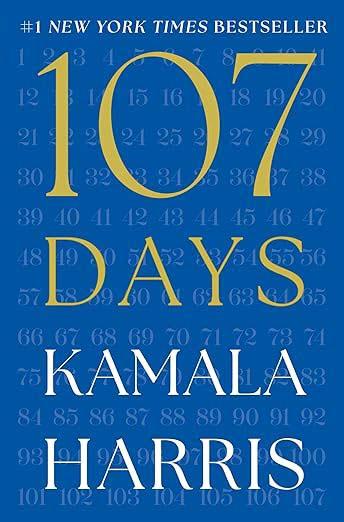
With an eye toward posterity, Harris’s “107 Days” has carefully detailed every single day of the campaign, from the day we all learned that former President Joe Biden would exit the race through the day after the election at Howard University and the election certification in January. The text is thorough, recounting in great detail some of the moments that the public had not been able to observe alongside seminal public events of the campaign. As a political scientist who has written about historical figures, I can say that a text like this is very important for the historical record. Fifty years from now, a young researcher who is seeking to understand what was happening in the campaign will have a clear accounting of the details, thanks to this text. However, as a Black woman, Democratic voter, and new mother who saw glimmers of a world in which my baby girl might live in the same city as a Black woman President of the United States, I found the book wanting.
“107 Days” does an excellent job of helping the public understand Harris’ rationale for certain decisions during the campaign and what happened in various moments. For example, we journey with Harris as she interviews vice presidential running mates over a weekend in August of 2024. Some parts of that private story are funny, like the vivid description of the three grown men — all vying to be the running mate — who were hiding in the backseat of a staffer’s 1999 Jeep Wrangler, so as not to be seen by the press.

Other moments are weightier. Harris shares an experience that many in the Howard University community know well, in which she had to balance her identity with her ambitions. Harris describes her preference to run with former Transportation Secretary Pete Buttigieg, and her fear of asking American voters to accept a woman of color and a gay man on the same presidential ticket. Ultimately, as we know now, she felt limited in her ability to follow her heart because of the judgements that others might make about her because she is a Black woman.
Setting aside my formal training and thinking about the book as a citizen who was rooting for Harris, I would love to have seen an even more reflective and vulnerable entrée into Harris’ life and experiences. For reasons most of us understand implicitly, I know very well why Harris cannot write the book I wanted to read yet, one that might be perceived as throwing former President Joe Biden completely under the bus or keeps it real about what it is like to live a life that has taken her from The Yard at Howard to the vice presidency of the United States of America. I also know that it is unfair to ask a person who is living in an unprecedented whirlwind of American politics to stop and talk about her feelings. It is even more unreasonable to ask a Black woman who is trained as a lawyer and who has spent the better part of her life in the public eye, working to curate and protect a public image, to allow a brutal public access to her deepest feelings. Yet, that is exactly what “107 Days” needed and — wearing my political scientist and strategist hats again for a moment — I would argue that is what Kamala Harris still needs.
To the extent that Harris has any weakness with Black voters, it is that we know who she is, but we do not know her “for real, for real,” as my students might say. Some showed up for her because that is what we have been taught to do (both for her as a member of the race and for the broader democracy), not necessarily because of intense feelings of closeness that people have described about previous presidential candidates or political leaders. This book was an opportunity to strengthen Harris’ connection to the people by extending the campaign beyond the very short 107 days she was given to re-introduce herself to the public.
All of us who were screaming at our screens when the outrageous scenes unfolded over the campaign want to know if Harris was screaming too. What does it feel like to know that you should have been the heir apparent to the presidency and to have that denied to you because your boss doesn’t want to leave the position? Were you as enraged as we were that the most qualified person for the Democratic nomination to the presidency actually had to argue with less qualified men in the party about this nomination? Was that hypocrisy as familiar to you as it is to us?
We want to know whether Harris’ heart also swelled with joy and pride in our moments of intense happiness and jubilation. Harris describes Day 104 by highlighting a speech in which she begins a sentence with the words “when I am president ...” In this moment, she writes, the excitement from the roar of the crowd drowned out the rest of the sentence. Harris supporters remember how we felt the first time we heard her speak that phrase. Harris accurately describes how those words helped us really see her as a potential president for the first time. However, the chapter ends before we learn how Harris herself felt in that moment. When all that hope and love was pointed in her direction, what was happening for her?
In my assessment, answering these kinds of questions would have drawn the disaffected masses more closely to Harris and made this book one for the ages — both important to future researchers and to the people living with her in this political moment. Asking a person to give this kind of intimacy to strangers is, again, unfair and an extremely difficult balance for a woman in leadership. However, I believe that it is what is required if we are ever to get to a place where Harris’ photo hangs in our mothers’ homes next to those portraits of Barack Obama.
I am hopeful that future writings from Vice President Harris will share with us in this way. The book’s afterward presents the first views of a potentially more unguarded Harris through an excellent framing of the future. In grappling with the question “what should we do [now],” Harris argues that solutions must come from outside Washington, envisions Generation Z as the key to our future, and the acknowledges that “the system is failing us.” The book tour has provided additional opportunities to observe Harris in her full personhood, such as when she stood to remind hecklers that “I am not president of the United States.” Between the afterword and the book’s press tour, I am left with the impression that Kamala Harris is better than “just okay” and that she has an important and deep story to tell us — even if she’s not exactly ready to do so just yet.
Keneshia Grant, Ph.D., is an associate professor of political science at Howard University.
MY TOE CAN'T GO
Dr. Victor Horsley’s Children’s Book Provides Early Diabetes Awareness and Education for Families
by Christen Hill
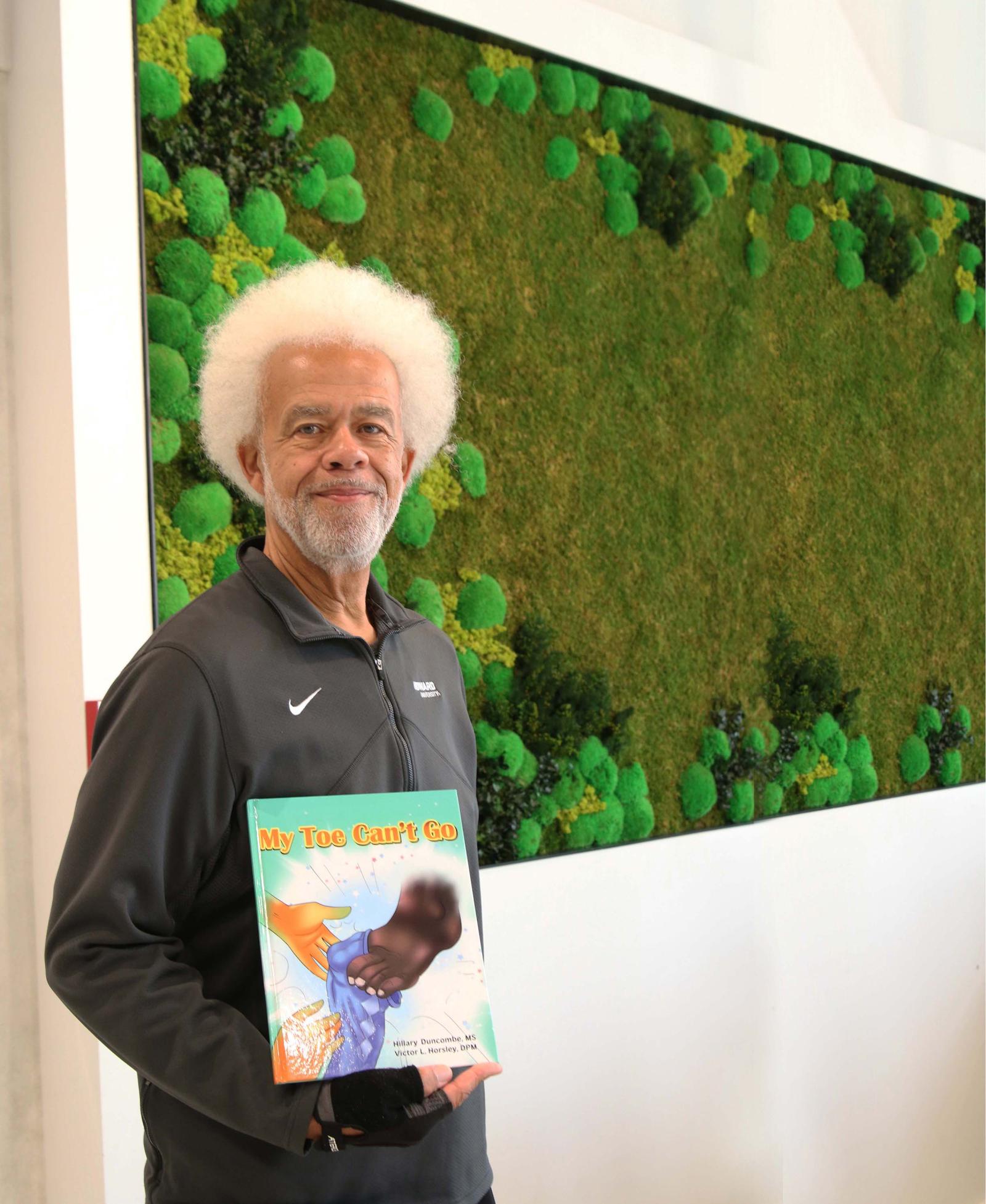
The children’s book “My Toe Can’t Go,” co-written by Victor Horsley, DPM, (B.S. ’75) and Hillary Duncombe, isn’t just another title — it is a call to action for everyone in the Black family to wake up and pay attention. Its mission is wrapped in colorful pages and characters embodied in everyday things familiar to children, like their favorite fruits and foods. The book centers on Ariel, a little pineapple girl who is faced with a major problem: her grandmother, “Grammyburger,” can’t feel her big toe due to diabetic neuropathy.
Diabetic neuropathy is defined by the Mayo Clinic as a type of nerve damage that can occur due to diabetes. Behind the gentle humor and whimsical illustrations of this children’s book lies a serious message about the power of early detection and education to stop diabetes-related amputations before they start. According to the National Diabetes Association, more than 38 million children and adults have diabetes in the United States. The association stresses early detection for this nationwide pandemic.
A proud graduate of Howard University and a podiatrist who has performed more than 15,000 foot and ankle surgeries, Horsley had seen too many lives forever changed by a preventable disease.
“Every 20 seconds, someone loses a limb to diabetes,” said Horsley. “And if we don’t act, that number will drop to every 15 seconds. But with this book, with awareness, we can stop 80% of these amputations before they happen.”
Ariel is a cheerful character who doesn’t understand how diabetes has affected a loved one. She and her beloved grandmother were caught off guard as the grandmother’s big toe became infected and unsightly. Many may feel that this subject matter is too mature to discuss with a child; however, much like recognizing the active symptoms of a stroke, normalizing this type of familial care and knowledge in the Black community is a truth Horsley believes we all need to accept. The book illustrates real world instances where a young child and an elderly person could be confused about what is happening regarding the elder’s health.
ONE TOUCH COULD SAVE A TOE, A LIMB, OR A LIFE.
It’s not until after Ariel alerts her mother, “Mommy Broccoli,” that the family meets with a podiatrist who teaches them about nerve health, good nutrition, and early testing for diabetic neuropathy. The story is playful enough to be palatable to children but layered with lessons for adults about the importance of plant-based eating, the dangers of too much processed oils, and the necessity of vitamin B for proper nerve function. In addition, this book is chock-full of healthy recipes, vocabulary words, and terms to help children learn how to help a loved one.
Horsley generously gives out copies of “My Toe Can’t Go” with a home testing kit and a tiny poking tool capable of detecting neuropathy five years before an amputation might occur.
“It starts with one touch,” Horsley said, holding up a thin monofilament wire. “One touch could save a toe, a limb, or a life.”
The book is also a love letter to Howard, Horsley’s alma mater. After celebrating his 50th class reunion, he returned to Howard determined to spread awareness not only across the campus but to communities around the world — from the Bahamas, where he practiced wound care for decades, to prisons and underserved neighborhoods in the United States.
“I came back to The Mecca because that’s where real change starts,” said Horsley. “The School of Social Work, Dr. Robert Cosby, and Miss Vera Fields have provided the wind for my sails to move forward and stop this global pandemic. We have done several health fairs and have made significant progress partnering with other visionary organizations.”
Through his storytelling and his science, Horsley is reminding everyone that health literacy begins early, and healing begins with knowledge. “My Toe Can’t Go” isn’t just a children’s book — it’s a blueprint for prevention, a call to action, and a bridge between medicine, education, and the legacy of Howard University.
Article ID: 2606