



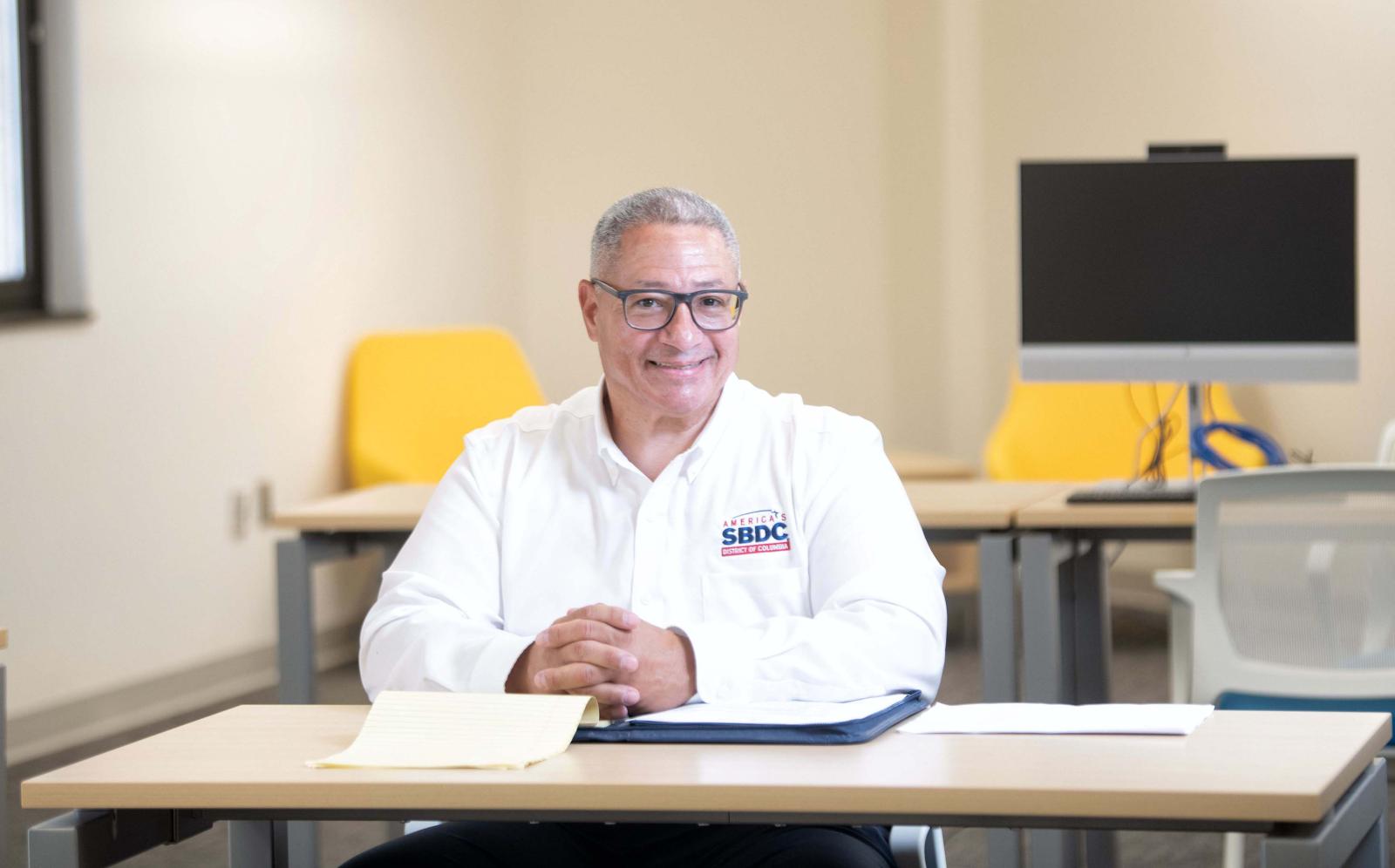
On most mornings in the Howard University School of Business, Carl E. Brown (B.A. ’83) walks into his office the same way he entered Howard as a freshman from Jamaica, Queens — focused, prepared, and already thinking about who needs help next.
Brown, now in his 10th year as director of the D.C. Small Business Development Center (DCSBDC), has spent three decades moving in and around Washington’s biggest development projects. He has brokered contracts, repaired broken systems, and coached hundreds of small businesses into stability.
DCSBDC is a partnership program nationally accredited by the Association of America’s SBDCs and funded in part by the U.S. Small Business Administration with Howard serving as the network’s headquarters. The program provides training, workshops, information, resources, and consultants who work with entrepreneurs in confidential, individualized sessions to help them with a range of business issues, including testing a new business proposition, shaping a business plan, investigating funding opportunities, and much more.
Brown’s story always loops back to a single belief: financial literacy. Now he’s taking that foundation in a new direction, arguing that Black communities urgently need education in philanthropic literacy, including the importance of giving back to Howard.
“Black people have to be taught how to give,” he said. “It’s got to be taught, because obviously we aren’t doing a good job of it.”
Brown promotes giving small but consistently. He argues that broad alumni participation strengthens the university’s capacity to make transformational requests to major donors. It also sends an important message to future students — the ones Interim President Wayne A. I. Frederick often described as “students arriving with $16 and a suitcase” — that the Howard ecosystem is still intact.
Brown attended Howard in the early 1980s, entering as part of a Brooklyn Technical High School pipeline that sent, in his words, “a whole crew” of academically driven students south. His first year in Slowe Hall became its own kind of classroom. Study groups turned into survival networks as classmates navigated the everyday struggle of paying for school. Howard, for Brown and his peers, was hardly the party campus it’s often portrayed to be.
“It was a pretty dry campus for us, not because of rules, but because nobody had money to buy anything,” he said. “Everybody was struggling, but everybody looked out for each other.”
Even then, Brown was absorbing early lessons about money — how it moves, who has access to it, and how literacy around it determines opportunity. While few used the term “financial literacy” then, Brown says he learned its concepts on campus long before he entered the working world.
Today, Brown is the only African American man among dozens of SBDC state directors across the country. Therefore, much of his focus has been on financial literacy programming, specifically in the Black community.
He said he made a major pivot during the pandemic. As Paycheck Protection Program and COVID-19 Economic Injury Disaster Loan relief programs opened, Brown watched Black small-business owners miss out — not from lack of effort, but because of problems he saw everywhere: a lack of understanding financial basics.
“It wasn’t discrimination in the way we talk about the 1960s,” he said. “This was a preparation gap — high credit utilization, bankruptcies, paperwork that wasn’t ready.”
In response, Brown hired CPAs, tax attorneys, former bankers, and credit specialists. He also wrote his own children’s series, “Sammy the Saver,” after realizing the literacy gap starts far earlier than adulthood. The books — which also feature a character called “Cash Money Carl” — were first printed under a Citibank partnership and have since made their way into classrooms across the country. Brown still mails out copies at his own expense.
He calls this work “guardrails,” coaching people who never learned the basics of credit, spending, delayed gratification, or long-term planning.
“If we don’t attack the financial literacy problem, we’re going to keep repeating the same cycles,” he said.
Now he’s putting a spotlight on a new gap — philanthropic literacy.
“We have to understand that earning well and giving back are not separate ideas,” he said.
Brown first learned that lesson firsthand from the late businessman Earl Graves Sr., founder of Black Enterprise magazine, for whom he once worked. He remembers Graves regularly spending big to sponsor tables at charity events.
“Earl Graves gave a lot,” he said. “I went to many, many, many dinners where he sponsored a table — 15, 20, 25 thousand dollars.”
Today, Brown says he sees a different pattern among young high-earning professionals who choose consumption over contribution.
“I talk to a lot of these young guys that are making good money, and their thing is, ‘I’ve got to buy another Benz, I’ve got to buy a bigger house.’”
For Brown, philanthropic literacy is vital for Howard’s future. Seated in the audience during Interim President Frederick’s State of the University address in October, he took note when the president said top-tier donors often ask a simple question: How many Howard alumni give?
“That stuck with me,” Brown said. “If the number is low, that’s a problem — not because people should give millions, but because participation matters. Momentum matters.”
Article ID: 2626