



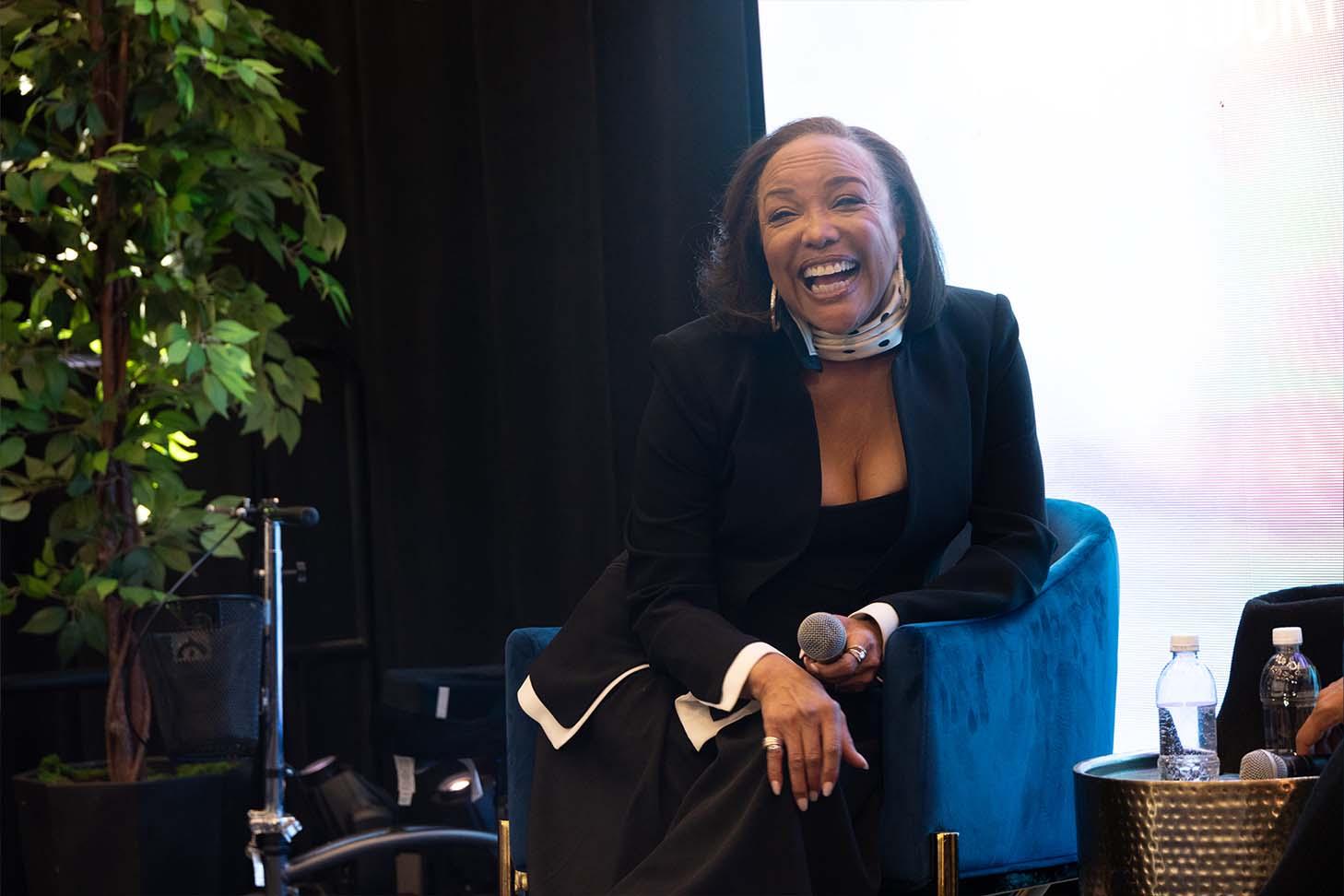
If you use the word “legacy” in a sentence describing Lynn Whitfield (BFA ’75), you must be specific. The Emmy Award-winning actress has become a Hollywood icon, gracing the stage, silver screen, and small screen while creating a body of work that spans decades. She is a bankable scene-stealer, leaving a legacy of open doors for women of color by starring in a wide array of pioneering roles, which proved that films and television shows featuring Black leads can achieve critical and commercial success. Though she has conquered virtually every acting genre, from drama to comedy, it is hard to deny that she has defined an acting niche all her own — portrayals combining elegance and fierceness in which the character’s beauty belies hidden complexities, desires, vulnerabilities, mental derangement, or even manipulative plotting. If a role calls for multidimensional interpretation, a good bet is that Whitfield is at the top of the call sheet.
Whitfield, born Lynn Butler-Smith, is also part of a Howard legacy. In fact, were it not for Howard, she might never have been born. According to the actress, both of her grandfathers went to Howard. Their children, Whitfield’s mother and father, became Bison as well, meeting and falling in love while students at the university before launching distinguished careers as leaders in finance, the arts, and dentistry in Baton Rouge, Louisiana. Whitfield became part of the legacy when she graduated from Howard with her BFA in theatre in 1975, having arrived during what she told Essence was a “renaissance” in fine arts at Howard, a time when Debbie Allen, Phylicia Rashad, Donny Hathaway, and Roberta Flack had all recently launched trailblazing careers using Howard as a springboard.
“The energy was all about us,” Whitfield told Essence, reflecting on her Howard experience. “There was no need for explanation about why we exist. There was no need to explain ourselves or who we were. That is just such rare air.”
The Emmy Award-winner and seven-time NAACP Image Award-winner came home to Howard in November 2025 to help guide the next generation of thespians. She participated in a star-studded panel discussion hosted during the HBCU First Look Film Festival held in Howard’s Blackburn Center Ballroom. Even with a fractured foot and limited mobility due to the cast boot she wore, she insisted on spending as much time as possible providing advice to students and answering the questions of aspiring actors, producers, content creators, and writers. Supporting the students at Howard was important to her, she said, because of her tremendous love for the institution.
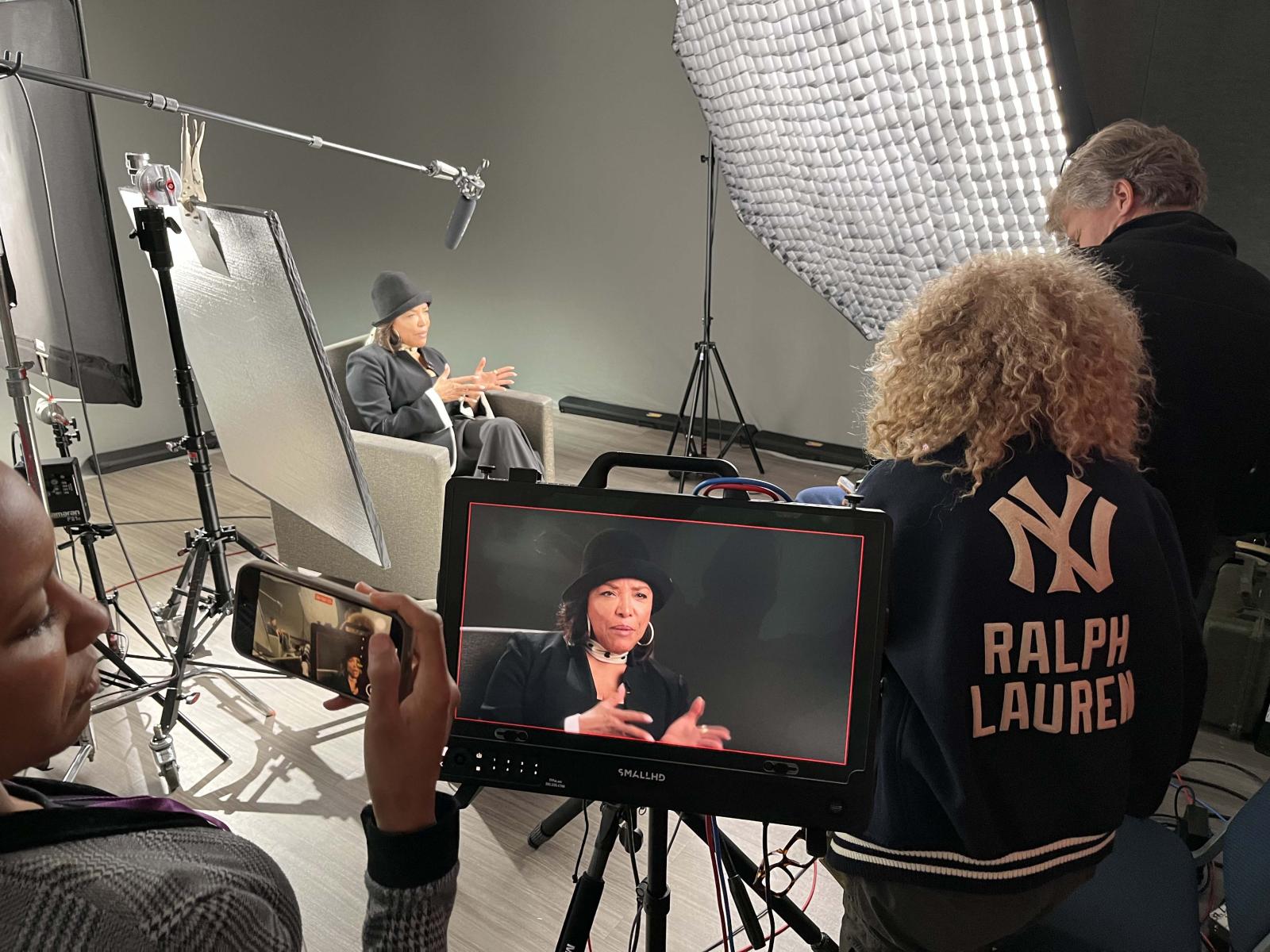
During the festival, she was honored along with other top stars during Café Mocha Radio’s 15th Annual Salute THEM Awards. Whitfield’s achievements in one of the toughest businesses are due to her enduring love of the profession and constant desire to try new things, a hunger she noted when giving advice to the Howard students watching the panel, revealing her desire to always work on different types of projects, such as science fiction. Ultimately, she said, she knows that she has been successful because her work has relevance to both younger and older audiences.
“I’m still like a kid, sometimes in the candy store, but sometimes outside the candy store,” Whitfield said. “There’s so much more that I want to do. What is already success for me is the longevity of telling stories. I’m still relevant, and generational legacy is success to me.”
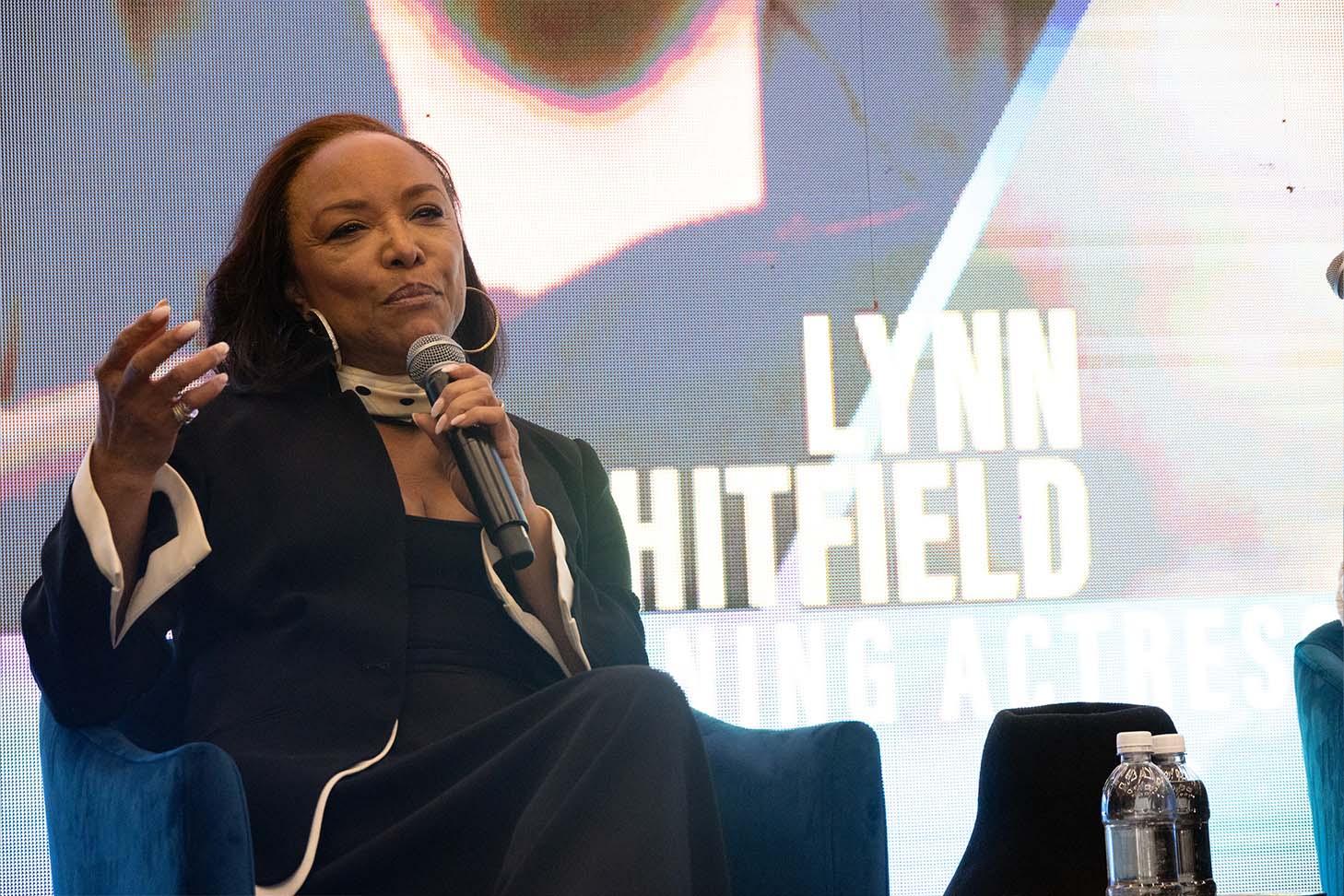
The audience of aspiring entertainers was treated to a master class on acting as a profession from the panel, which also included Keith Robinson of “Dreamgirls” fame and panel moderator Cori Murray of Ebony magazine. Whitfield spoke about the changing environment of auditioning, which is now often done virtually instead of through traditional casting calls involving numerous actors in the same place and aspiring for the same role. She also touched on the importance of understanding the business side of the profession, including management of agents, accountants, and others working on behalf of the artist.
Whitfield is not shy about acknowledging how much she benefited from her time at Howard and in Washington, D.C. While at Howard, she took full advantage of the Washington theatre scene, becoming a member of the D.C. Black Repertory Company, attending workshops late into the night, and then making it to class early the next morning. The work paid off. By 1977, a few years after graduation, she was performing on stage with Alfre Woodard in Ntozake Shange’s “for colored girls who have considered suicide / when the rainbow is enuf,” one of the first plays by a Black woman playwright to reach Broadway. During her November 2025 visit to Howard, she credited the university with fostering a safe environment that nurtured creativity.
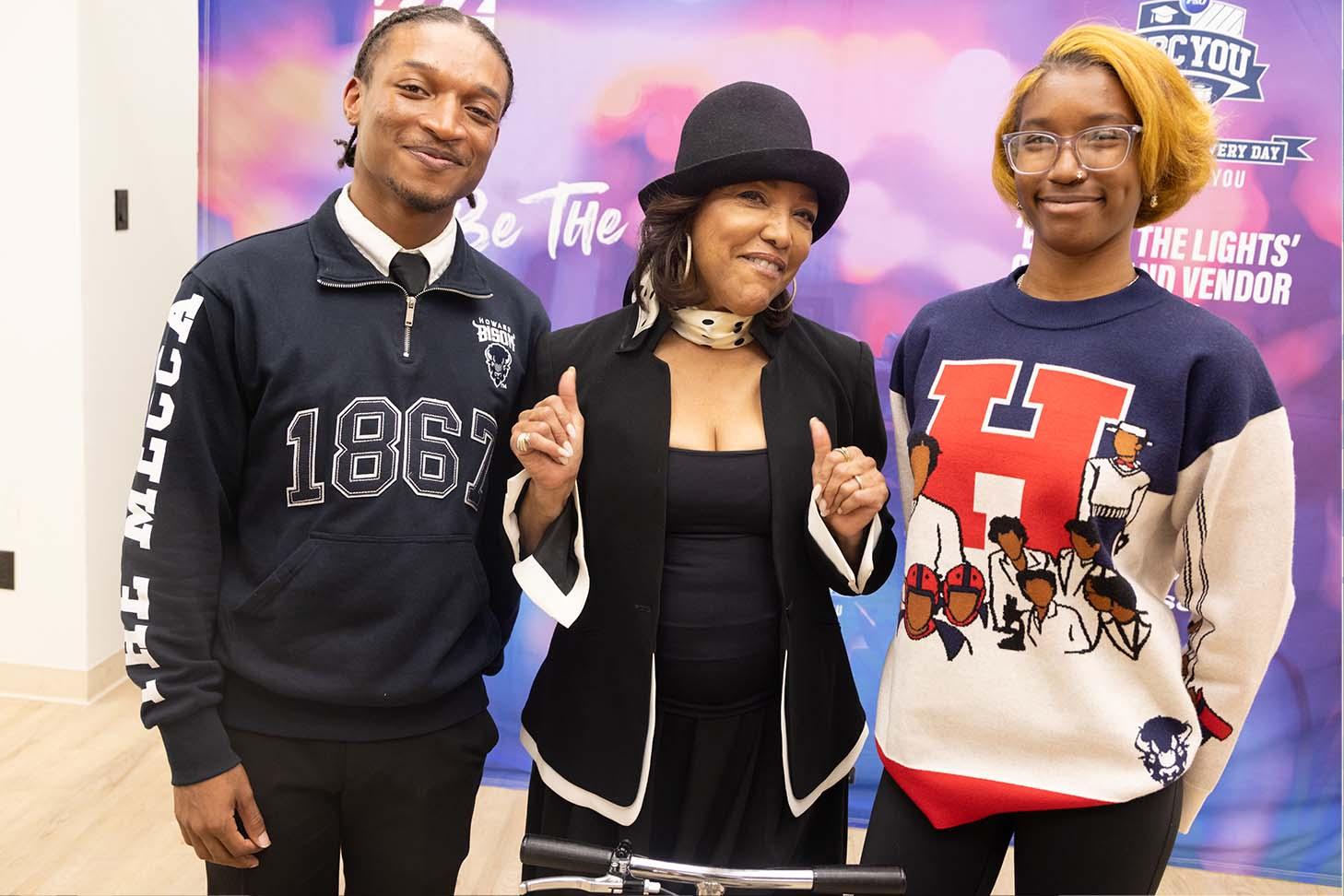
“Everybody is working on the craft,” she said of Howard. “Everybody has a goal of excellence. It’s a workshop. It’s a lab. It’s a sandbox. It’s a playroom, [where students are] able to try things without the high stakes of a fear of failure that would really hit your pocket or hit your heart, [with] support from everyone pulling for you to do well.”
Whitfield exudes confidence and glamour, and she has achieved A-list visibility while racking up numerous high-profile accomplishments. Her career path may look easy, but it has not come without an extraordinary amount of effort, patience, and dexterity. During the panel at Howard, Whitfield encouraged students to be clear about their passion and their willingness to devote the enormous amount of time and sacrifice needed to perfect the craft. She noted that she is willing to guide and mentor emerging thespians, but only if they are putting in the work to demonstrate their commitment.
“It takes a lot of time and energy to mentor someone,” she stressed. “I think that young people who want mentors can get them by doing the work that is deserving of the people whose attention they want. Everybody can talk a good game, but when you show me that you have mastered it to a point [where] my attention can help, then that’s when you can get me. When a person shows promise, when they show me that they care, I’m on it like white on rice, because we need more excellence, we need more excitement, and we need more storytelling.”
Whitfield is the rare actress who has been introduced to successive generations in new ways during multiple iterations of her legendary career. Early on, she appeared in an array of the most popular television shows of the 1980s, including “Hill Street Blues,” “Cagney and Lacey,” “Mike Hammer,” “Miami Vice,” and “Matlock.” She also starred alongside Oprah Winfrey and an ensemble cast of leading women in “The Women of Brewster Place,” a groundbreaking miniseries about Black women navigating various traumas with dignity and self-reliance. In addition, she had roles in movies such as “Jaws: The Revenge,” “Doctor Detroit,” and “The George McKenna Story,” where she was the lead actress opposite an ascendant Denzel Washington.
Whitfield’s breakout role came in 1991, when, after a six-month auditioning process, she landed one of the roles perhaps most highly coveted by Black actresses: Josephine Baker. Baker is often regarded as the first woman to become a global superstar, using a sultry and sassy showmanship to become one of the most sought-after performers across multiple continents, particularly Europe. Her dance performance in little more than a makeshift skirt of bananas made her an instant symbol of the Jazz Age, and she was the first Black woman to star in a motion picture. She leveraged her celebrity to spy for the Allied forces during World War II and provided shelter for those fleeing attacks by the Axis armies, earning numerous awards and commendations for her brave service as part of French military intelligence. She adopted a multiracial group of children, which she called the “Rainbow Tribe,” and became a champion of civil rights in the United States, where she refused to perform before segregated audiences and eventually forced many venues to integrate. She spoke alongside Dr. Martin Luther King Jr. at the seminal 1963 March on Washington.
A believable portrayal of Baker called for someone with extreme versatility, which Whitfield fully brought to bear. Not only did she elucidate the many complexities of Baker’s life, but she also embodied Baker as she aged across a 60-year period. Whitfield’s daring and electric performance in the role more than met the moment, earning her an Emmy Award for Outstanding Lead Actress in a Miniseries or a Special, an NAACP Image Award, and a Golden Globe nomination.
With younger audiences not familiar with Baker, Whitfield became known for her role as the well-off older girlfriend of Martin Lawrence’s character in the dark comedy “A Thin Line Between Love and Hate.” She again showed her multilayered acting chops, playing a character who seemingly had it all together, but who had psychotic tendencies lingering just below the surface. Later, in 1997, she starred as family matriarch Roz Batiste in “Eve’s Bayou,” struggling to hold her family together even as her husband, portrayed by Samuel L. Jackson, philandered about town and her daughters experienced their own related growing pains, accentuated by an infusion of Voodoo. The film was selected by the Library of Congress for inclusion in the National Film Registry.
This century, Whitfield has continued to showcase the diverse nature of her acting ability, tackling roles which included the mother of Raven-Symoné’s “Galleria” character in Disney’s highly successful “Cheetah Girls” movies; a recurring role in “How to Get Away with Murder;” and a Democratic Party operative in Chris Rock’s movie “Head of State.” Beginning in 2016, she took on a lead role as the manipulative first lady of a Memphis church during five seasons of the Oprah Winfrey-produced “Greenleaf” series. More recently, she starred for two seasons as Alicia in “The Chi,” a central character on a quest to find the murderer of her son before (spoiler alert!) she was herself murdered in the 2025 series cliffhanger. Her performance in the role landed her an NAACP Image Award for Outstanding Supporting Actress in a Drama Series.
Such a dynamic career involves a heavy dose of self-reliance, a helping of faith, and the ability to quickly seize upon fast-moving opportunities. While home at Howard, during a full circle moment in which she addressed students with the same zeal she had when she attended the university, Whitfield encouraged each aspiring actor and filmmaker to embrace God’s purpose for their lives and to protect the part of their spirit that embraces possibilities. She cautioned that the world is set up “to stop you, not to catapult you.” The only way to combat an arrested momentum, she said, was to “keep it moving.” She also revealed her ultimate recipe for realizing your dreams — refusing to take no for an answer.
“Take charge,” she said. “If you believe in your words, your characters, and your stories, then find a way for people to see them somewhere and keep it moving until somebody says yes.”
Article ID: 2556