



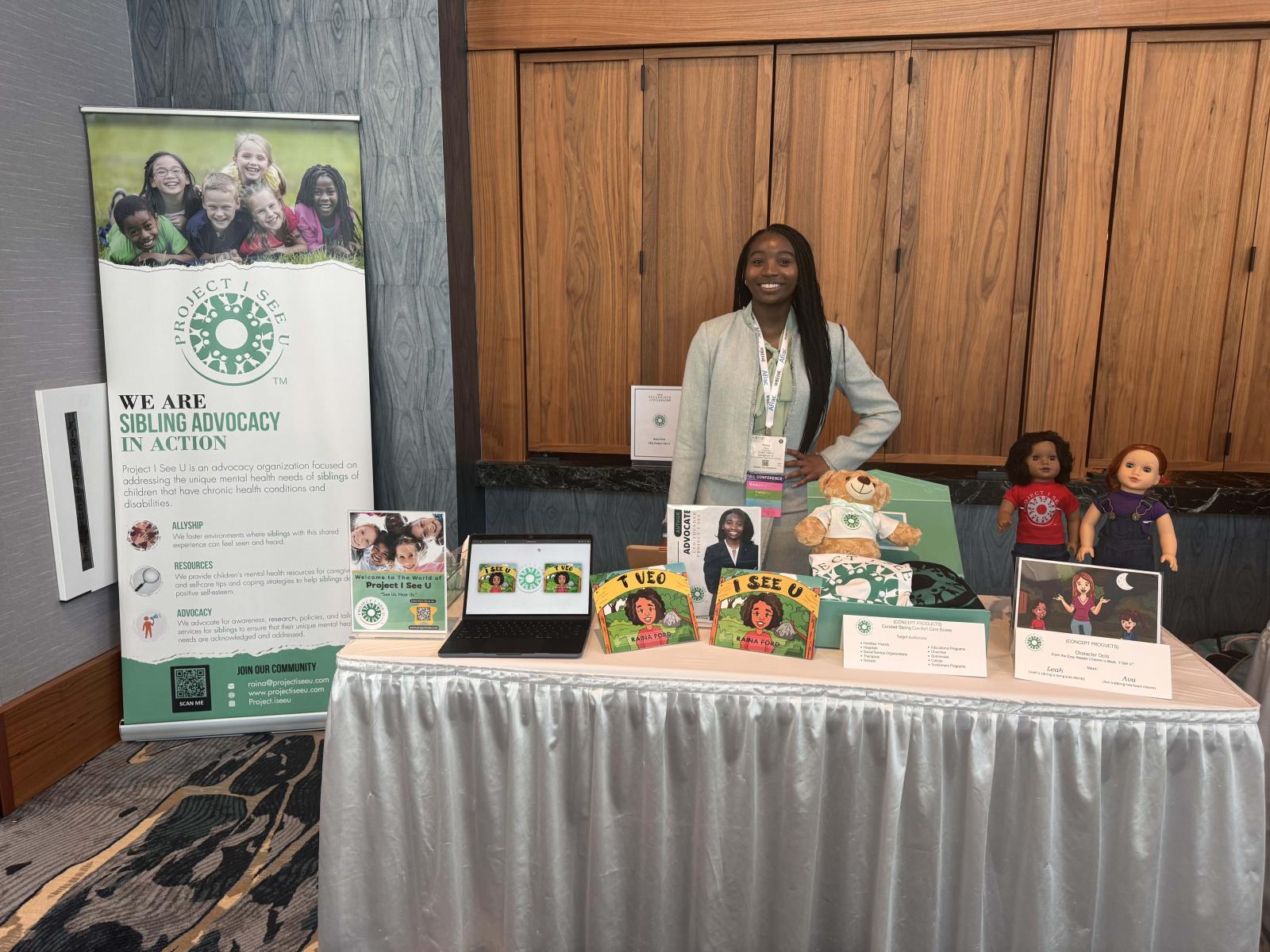
Howard University has long been a beacon for talented students who enroll because they want to make a difference in their world. Others, like Raina Ford, come to Howard because they are already making a difference. As early as the eighth grade, she saw a problem and did something about it — writing a book, “I See U,” to help children whose siblings have special medical needs understand how to navigate their own feelings and need for attention.
Her goal was to draw attention to the effect of adverse childhood experiences (ACEs) and those who suffer associated traumas, including millions of “glass” children who may feel isolated, ignored, and unimportant in families where much of the attention is understandably directed toward family members with health challenges. Those children can experience a range of emotions, including anger, frustration, jealousy, and confusion, especially when parents try to protect the child from the fear of uncertainty and are less than transparent in explaining what is happening. They can develop mental health issues that last a lifetime, such as low self-esteem, feelings of inadequacy, social withdrawal, and difficulty trusting others. In many ways, the book elucidates Ford’s own personal journey, which she shares to light a pathway for others like her to help them discover the talents that make them special and feel seen and heard.
“Ultimately, I have a personal connection,” Ford said. “My older sister has a disability, and so it’s really a personal passion project. Growing up, I felt many emotions and was trying to navigate that myself. I’m just trying to be the resource that I wish I had when I was younger.”
Fast forward to her junior year as an international business major at Howard, and Ford’s book has become the foundation for a full-scale social and entrepreneurial enterprise. Her company, Project I See U, is laser-focused on providing products and services that make life better for individuals affected by ACEs and is working to amplify advocacy and foster allyships so affected people can connect with other individuals and organizations which offer support.
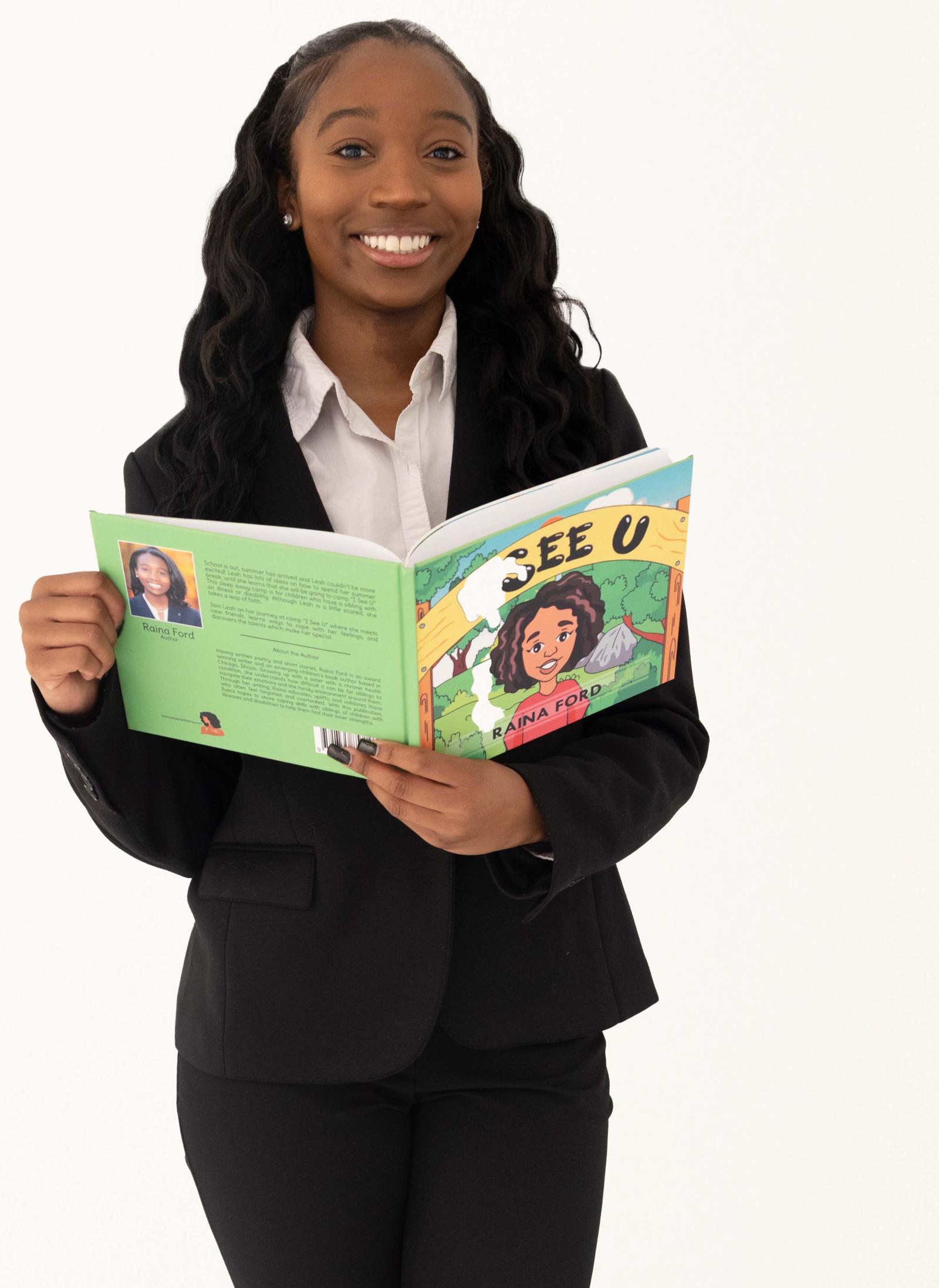
In addition to her first book, Ford sells I See U-branded backpacks. More books are also in the works addressing other dynamics a child may confront, such as interacting with family members who have developmental disabilities or cardiovascular challenges, traveling to hospitals and spending time there while an ill family member receives treatment, and being cared for by people other than their parents while their parents’ attention is elsewhere. In addition, she sponsors children attending summer camps where they can develop a sense of identity.
“Our materials help children develop positive coping skills that they can take into adulthood to better equip them in managing their emotions and ultimately give them a sense of resiliency,” Ford said.
Ford noted that her company is in the first phase, and she wants to eventually expand its mission to address issues such as gun violence and experiences in foster care. Her parents are part of her operational team, as are a clinical psychologist and a social worker. Much of their work is designed to educate by sharing research and information.
Ford’s experience at Howard has supercharged both her confidence and her ambition. Even as a freshman, she dove into the deep end of the entrepreneurial pool, competing in pitch and small business incubator competitions against far older students — and winning.
“My freshman year, I participated in the WBENC [Women’s Business Enterprise National Council] Entrepreneur Incubator Program and won first place, going against upperclassmen and some graduate students,” she said. “I think that really boosted my confidence and helped me understand that I am not only a good communicator and storyteller, but also that my business resonates with other people and that I can clearly communicate its mission to others. That helped me a lot, and since then, I’ve just been constantly looking for more opportunities.”
Her participation in other competitions and programs, such as those offered by the Howard University and PNC National Center for Entrepreneurship, helped her connect with a community of Howard students who are working to grow small businesses. She’s also taken advantage of opportunities to network with corporate executives and to find faculty and staff members willing to advocate for her, such as School of Business Assistant Dean Sharon Strange Lewis. Those connections ultimately helped prepare her to take her biggest leap yet, competing on Revolt TV’s “Bet on Black” HBCU Pitch Competition.
In the competition, nine HBCU student entrepreneurs participated in a series of televised, high-pressure challenges which required inventive presentations. First, the students had 60 seconds to create a compelling narrative, target audience strategy, and sales pitch for an empty jar. Next, the students had three minutes to craft a direct message on their mobile phones that would convince a potential business partner to meet with them. Then, students had a minute to deliver their “elevator pitch” to the judges, explaining their vision for their company and why it was worthy of investment. Finally, the students gave their “ultimate pitch,” a presentation to the judges detailing their business models. Ford used her extensive research on ACEs to explain the economics of her product and service offerings, and how her company would leverage the millions spent each year to support children who are impacted. She explained her company’s plans to expand into production of curated boxes, journals, notebooks, and toys, as well as its engagement in animated film and television ventures and sponsorship of youth enrichment activities, including a summer camp.
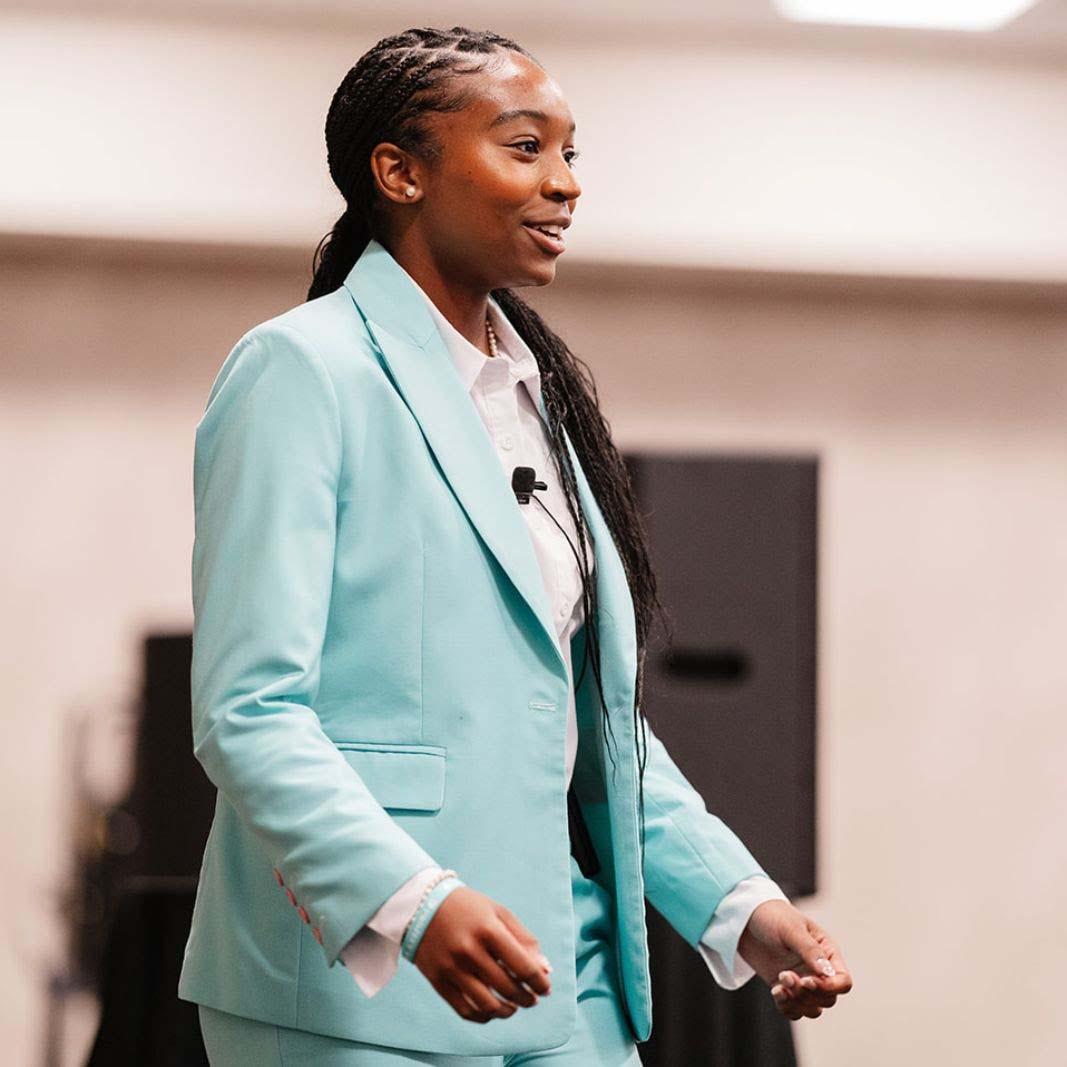
“We do this because we recognize that childhood matters,” Ford told the judges. “I plan to revolutionize the way that we approach adverse childhood experiences, and I [invite] you to join this journey with me.”
The judges were highly successful business owners who have set new standards for entrepreneurship, including Ryan Wilson, co-founder and CEO of The Gathering Spot; Janell Stephens, founder and CEO of Camille Rose; and former NBA All-Star and serial entrepreneur Baron Davis. Ford won the judges over and took home the grand prize of $30,000 and a tablet to grow her business.
“What I loved about your pitch is that you’re solving a problem; you identified the problem and how you are going to solve the problem,” Davis told Ford. “I was like, ‘you should be pitching my company for me.’”
Ford credits the skills she is learning at Howard with helping to fuel her forward momentum. Her orientation class was pivotal, she said, teaching her the skills she needed to conduct herself at meetings, speak in public, and deliver team presentations — all of which she used to win the Revolt competition. Now, she is mastering the art of negotiation, another realm of skill development at just the right time as she seeks to scale her business.
“My negotiations class has really pushed me into doing research, formulating strategies, and strategic planning, and then being able to pivot and think quickly on your feet,” she said.
Ford is well on her way to achieving her primary career goal — combining her interests in writing, entertainment, and marketing. She is using Howard as her laboratory by embracing both academic and co-curricular opportunities to grow her skill set. She serves as chief of staff for the HU Entrepreneurial Society, where she and her fellow entrepreneurs participate in business opportunities like “pop-up shops,” where they sell their goods around campus. She’s also a member of Delta Sigma Theta Sorority’s Alpha Chapter. Though it can be intimidating to be among so many high achievers, Ford has learned to embrace Howard’s culture of excellence and lean into the force of her own agency.
“I came to Howard to have the opportunity to gain a better sense of myself and be around people who were high achieving and look like me,” she said. “I know we’ll go on to do big things, and I’ll have the opportunity to call them my peers and classmates.”
As she pushes forward into her future, Ford knows that the most important person she needs to believe in her vision is herself. Howard, she said, has taught her how to stop comparing herself to others and focus on her own success. Most importantly, she said, Howard has shown her the importance of raising her own voice.
“The biggest thing I’ve learned at Howard is the importance of advocating for myself and learning that I am my biggest cheerleader,” she said. “Early on, I had to get over being shy about telling people about my business or sharing my successes, and I learned that nobody else is going to hype you up more than yourself.”
Company: Project I See U
Website: projectiseeu.com
Instagram: @project.iseeu
Article ID: 2581